Dev log 1: hello from the control room
Our next game after Rail Route: what Port Control is, why a seaport, and what the prototype already does two weeks in.
We are the small team behind Rail Route, the train dispatcher game. Port Control is our next game, and this is the first of the notes we will write while we build it.
The pitch
You run the traffic of a busy seaport from the control room. Ships cannot stop, tides open and close the door, and the port never sleeps.
In a real port that job has a name. The vessel traffic service answers the radio as “Port Control”, and every ship that comes in or goes out talks to it. You are that voice.
Why a seaport
Rail Route taught us that a real, unglamorous control-room job makes a great game when you can read it at a glance and automate it as you grow. A port is the same job at sea, and the parts map one to one: channels are block sections, berths are platforms, the tide is the timetable.
What changes is the physics. A train stops at a red signal. A laden container ship needs kilometres to lose her way, so a conflict has to be seen early, and a plan has to hold for the ten minutes she needs to carry it out.
Where we are
Work started in the middle of September. What you can do in the prototype today:
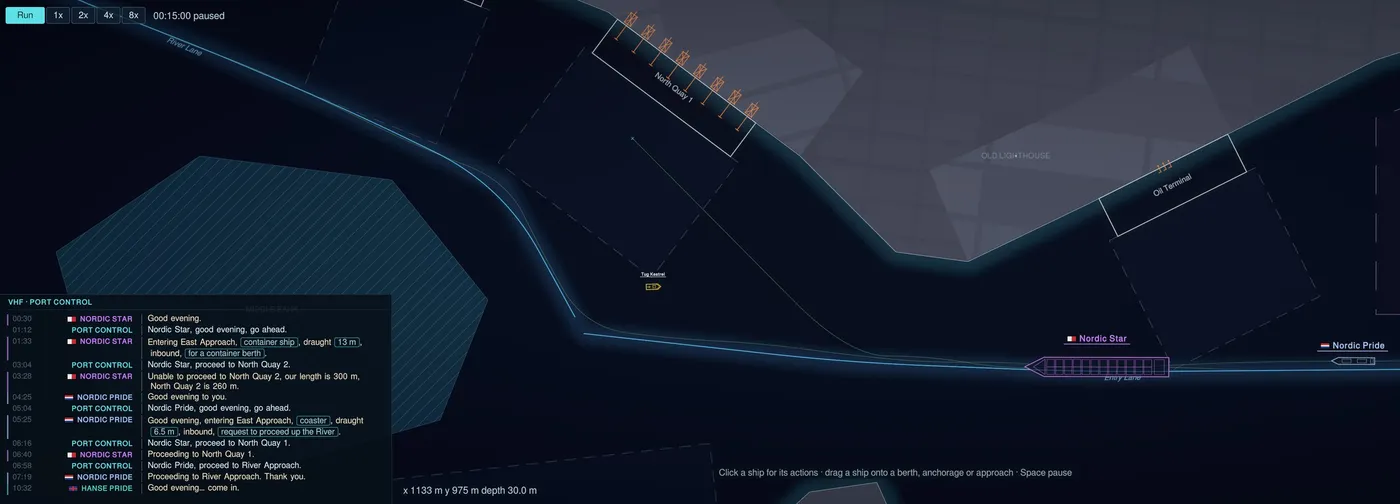
- Ships enter at the edge of the map and call you on VHF. You answer, they report who they are and what they want, and every exchange lands in the radio log.
- You instruct them: hold, proceed to an anchorage or a berth, change speed. They read back and do it, with all the momentum a big hull has.
- You send a pilot boat, and the pilot boards under way. With a pilot aboard, the ship takes direct orders and follows lines you draw.
- You make tugs fast to a ship’s tie points and push or pull her alongside.
- Berths take requests: a ship asks for one, you approve it and place her along the quay.
- A map editor in the game paints land and depth and places quays, lanes and anchorages.
The picture above is straight from that build. Every colour, line and label in it will change; the look is one of the things we are working on right now.
What is next
The traffic itself: which ships come, when, and what they want. A port lives on regular liner calls with spot traffic in between, and the next step is designing how that week of traffic reaches you.
If you want to follow along, join the list: you get each dev log by email and a note on the day the Steam page opens. We would love to hear from you on the forum too.